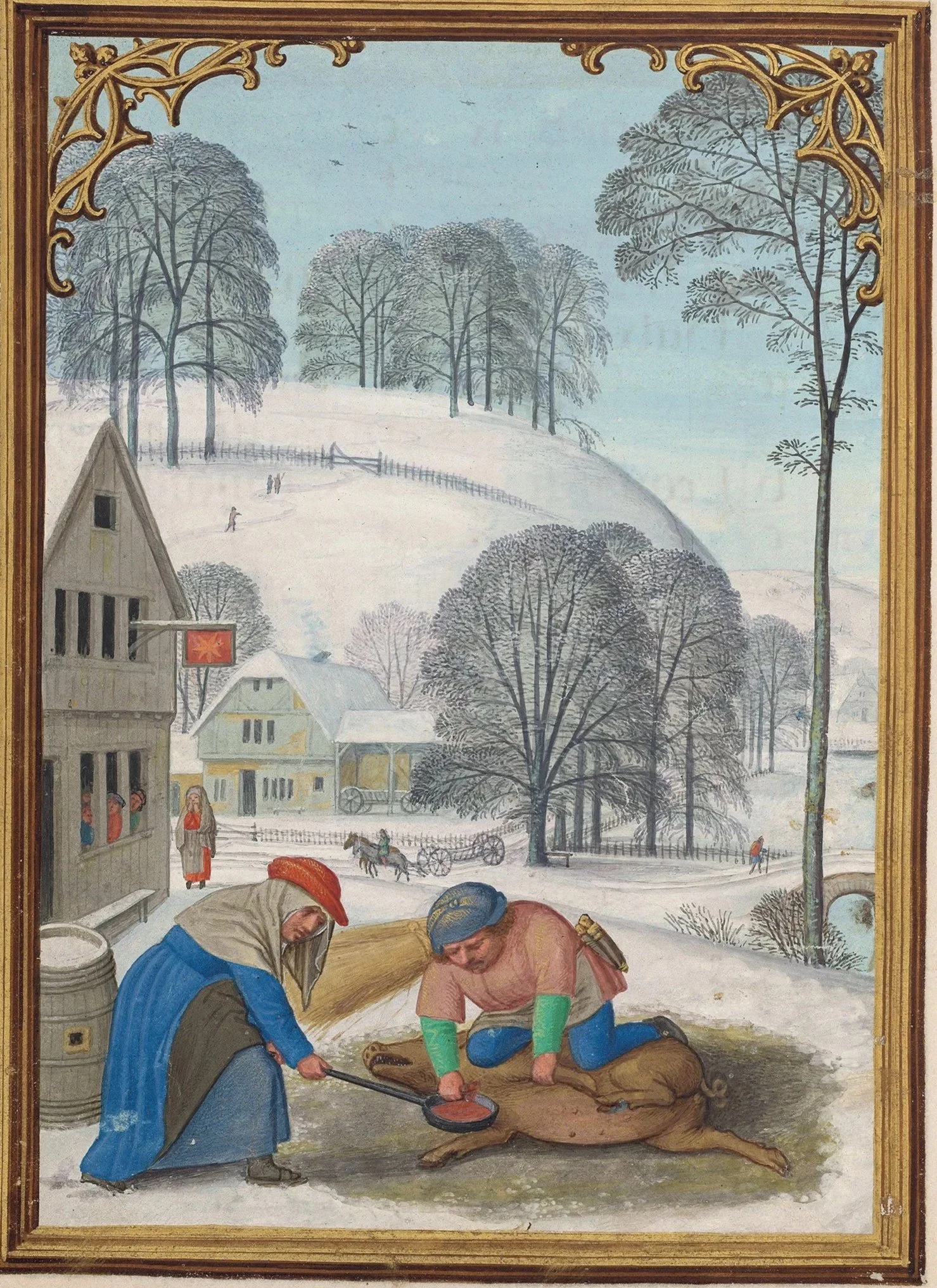
“December,” Da Costa Hours, Morgan Library MS M.399, fol. 13v, 1515.
When Eve Delved: Gender, Nature, and Labor in the 15th Century examines texts such as the animal fables of Robert Henryson, Margery Kempe's Book, and Cycle Plays. Focused on the 15th century when the unseasonably warm climatological era known as the Medieval Warm Period ended and bleak winters and torrential rains were occurring with increasing frequency, this project studies how literary images of women's agricultural labor transformed with the changing climate. It suggests that the imagery and narrative of women's labor was an important site around which medieval and early modern writers negotiated their anxiety about living in and alongside a natural world grown colder and seemingly more hostile. A chapter from this project, “Something Rotten: Retting, Slow Violence, and Imprudent Ecology in Henryson’s Preaching of the Swallow” is forthcoming in Studies in the Age of Chaucer (2027).
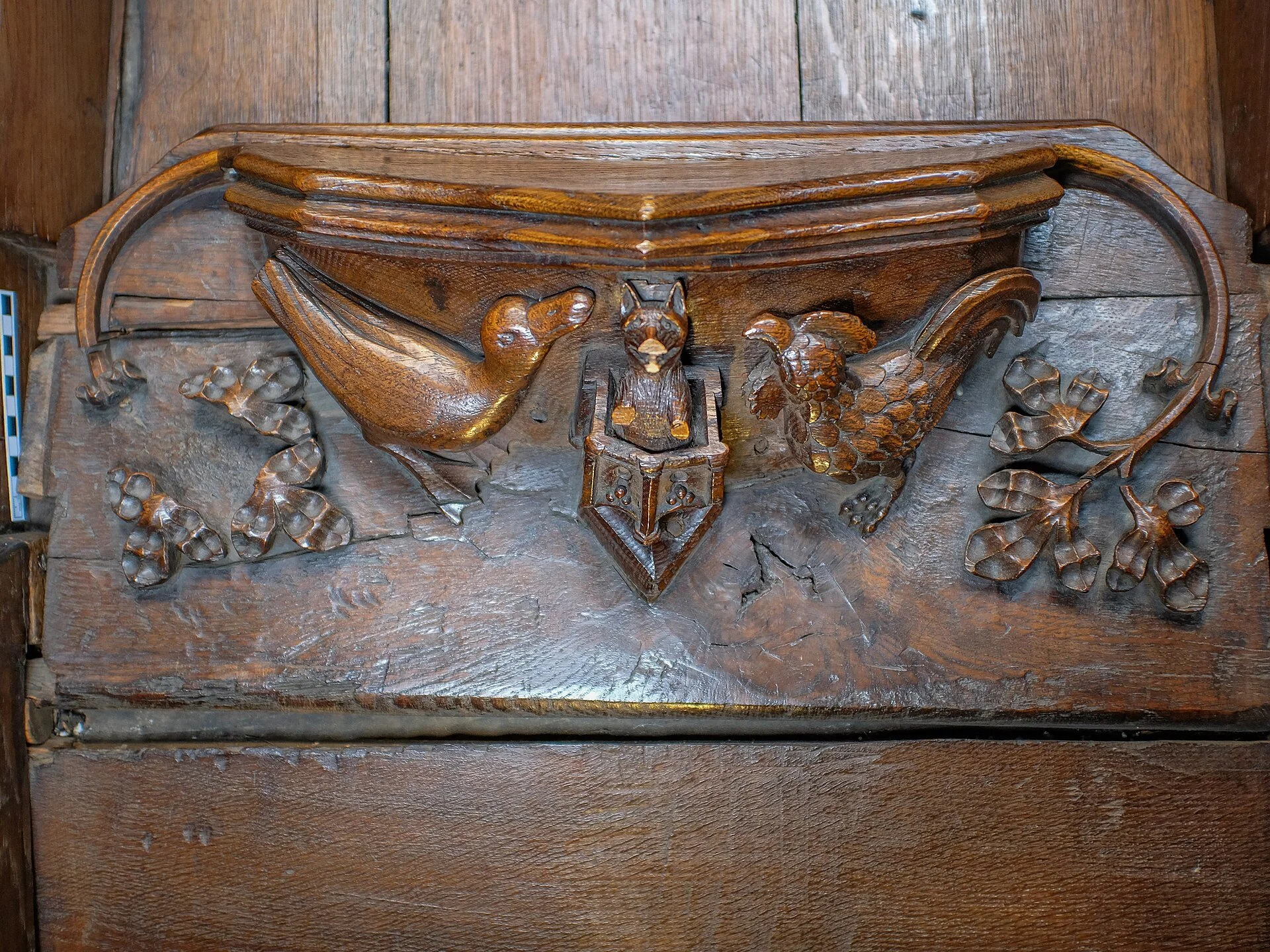
Underside of seat N11 of quire at Ripon Cathedral with misericord carved in oak. Reynard the Fox preaching to the gullible fowl.
This project has been supported by a series of research assistants. In Summer 2025, Joao Garcia assisted me in cataloguing discussions of the weather in medieval chronicles and in cataloguing representations of the seasons in late medieval books of hours. As a part of this project he produced a detailed catalogue, which can be found here. He also produced a website based on his cataloguing that considers the intersection of gender and labor in medieval books of hours; that website can be found here. Additional student researchers, Chedin Manley and Nia Prinster, are working with me to catalogue fables in misericords, sermon exempla, and bestiaries.
Support for these student researchers came from Whitman College’s Summer Student-Faculty Research grants; these grants were generously funded by the Jim Soden Faculty Student Research Endowment, Louis B. Perry Summer Research Endowment and Academic Excellence-Whitman Fund.